
Acceleration
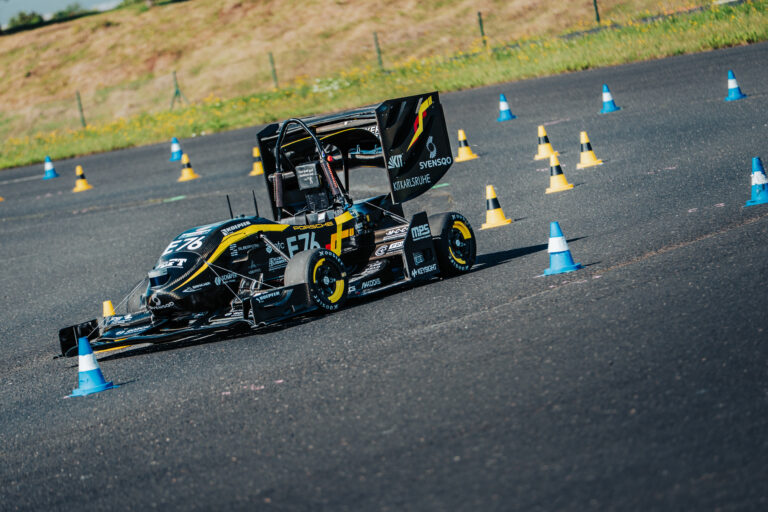
50 PointsThe Acceleration event evaluates the car's acceleration in a straight line on a flat pavement. The car starts from a standstill and completes a 75-meter sprint as quickly as possible.
This discipline tests the powertrain's torque output, the available tire grip, and the suspension tuning to maximize power delivery without spinning the wheels excessively.
Driverless Acceleration
75 PointsIn Driverless Acceleration, the autonomous system is tested for its ability to guide the vehicle in a straight line for 75 meters without human intervention.
The challenge lies in smoothly deploying peak power while the perception and control algorithms ensure the car remains perfectly centered between the track boundaries.
Skidpad
50 PointsThe Skidpad event measures the car's cornering ability on a flat surface while making a constant-radius turn. The track is laid out in a figure-eight pattern.
It acts as a pure test of the vehicle's lateral grip, aerodynamics at low speeds, and suspension geometry, demanding high maneuverability and driver precision.
Driverless Skidpad
75 PointsSimilar to the manual Skidpad, the Driverless Skidpad forces the autonomous system to navigate a figure-eight course aggressively.
The autonomous pipeline has to reliably map the tight cornering cones and steer with high lateral acceleration, maintaining stability near the grip limit.
Autocross
100 PointsAutocross is a single-lap sprint on a tight, winding track. It evaluates the car's maneuverability and handling qualities without the obstacle of other cars on the track.
This event serves as the ultimate test of the vehicle's overall dynamic capabilities, combining acceleration, braking, and cornering into one complex driver challenge.
Driverless Autocross
100 PointsThe Driverless Autocross evaluates the autonomous system's ability to map an unknown track (usually during the first lap) and subsequently optimize the racing line to achieve the best possible lap time.
It is a highly demanding test of the vehicle's SLAM (Simultaneous Localization and Mapping) algorithms and path-planning performance.
Endurance
250 PointsThe Endurance event is the pinnacle of the competition: a 22km race that tests the overall performance and reliability of the car.
A mandatory driver change happens halfway through the race. This event is the most heavily weighted in the competition because finishing it requires a highly robust engineering approach.
75 points are additionally awarded for the efficiency of the car, which is measured by a competition provided current sensor fitted to all cars.
Trackdrive
200 PointsTrackdrive is the equivalent of the Endurance event for driverless vehicles.
The autonomous car must complete a set number of laps (usually 10 laps) autonomously, proving the long-term reliability and consistency of both the hardware and the software stack without human intervention.
Business Plan
75 PointsIn the Business Plan Presentation, the team role-plays as a company pitching a business model to fictional investors.
The product pitched must be tied to the race car, demonstrating the team's ability to develop a profitable business model, effectively analyze target markets, and present a compelling financial case.
Engineering Design
150 PointsDuring the Engineering Design event, students must defend their design choices in front of judges who are industry professionals.
The judges evaluate the engineering effort that went into the car, focusing on whether the design meets its goals, the methods used to validate those designs, and the team's overall understanding of automotive engineering.
Cost and Manufacturing Analysis
100 PointsThe Cost and Manufacturing Analysis requires the team to thoroughly document the manufacturing processes and costs associated with building the car.
This event challenges teams to think about the economic viability of their prototype, teaching students how engineering decisions immediately impact manufacturing complexity and budget.